Disaster Communications Quick Start Kit
A practical communications resource for community foundations
This guide was prepared for the Council on Foundations by ECPR Texas, as part of Communicating Around Disaster: A Crisis Communications Workshop. Download this guide as a PDF.
Jump to section:
Disasters demand timely, accurate and compassionate communication. While every situation is different, the principles of effective communication remain the same. Use this quick-start guide to help your organization communicate with clarity before, during and after a disaster response.
BEFORE A DISASTER
Build your communications foundation.
Priorities
- Educate your community about your role before a disaster occurs.
- Explain how disaster funds work before they're needed.
- Identify internal communications roles and spokespersons.
- Prepare answers to common questions and misconceptions.
- Build relationships with local media and community partners.
Ask yourself
- Who approves public messaging?
- Who serves as spokesperson?
- Are our website and social media channels ready for emergencyupdates?
- Do we have clear messaging that explains how our disaster fundworks?
DURING A DISASTER
Lead with empathy. Communicate with clarity.
Priorities
- Acknowledge what has happened with empathy.
- Confirm facts before sharing information.
- Clearly explain your organization's role.
- Communicate consistently across all platforms.
- Monitor misinformation before deciding whether to respond.
Remember, your audience does not expect you to have every answer immediately. They do expect timely updates, honesty about what you know and transparency about what comes next.
AFTER THE IMMEDIATE RESPONSE
Recovery is a communications opportunity.
Priorities
- Continue communicating as recovery continues.
- Share impact and community outcomes.
- Thank donors, partners and volunteers.
- Demonstrate stewardship of donated funds.
- Capture lessons learned for future responses.
FIVE COMMUNICATION PRINCIPLES
- Lead with empathy. People remember how your organization made them feel as much as what you said.
- Communicate early. You don't need every answer to begin communicating.
- Be transparent. Clearly explain what you know, what you don't know and when you'll provide updates.
- Stay consistent. Ensure your website, social media, media interviews and donor communications reinforce the same key messages.
- Build trust over time. Trust is earned through clear, honest communication before, during, and after a disaster.
Before publishing any communication, ask:
- Is it accurate?
- Is it empathetic?
- Does it clearly explain our role?
- Does it answer what our audience needs to know right now?
- Does it build trust?
Pre-Crisis Preparedness Checklist
Organizational Readiness
- Identify communications lead
- Identify backup spokesperson
- Review disaster communications plan
- Confirm approval process
- Update media contact list
- Review website emergency page
Messaging
- Prepare disaster fund explainer
- Develop holding statements
- Draft FAQ
- Identify key audiences
Digital
- Confirm social media access
- Review emergency website updates
- Test email platform
Relationships
- Meet with local media
- Coordinate with emergency partners
- Preview key emergency plans/messages to board leadership
During-Crisis Messaging Checklist
First 24 Hours
- Confirm facts
- Determine what is known
- Acknowledge uncertainty
- Publish first statement
- Update website
- Notify board
Communications
- Lead with empathy
- Explain your role
- Reinforce disaster fund purpose
- Correct misinformation when necessary
- Keep messages consistent
Internal
- Staff briefing
- Board update
- Monitor media
- Monitor social media
Post-Crisis Reinforcement Checklist
Stewardship
- Report impact
- Share outcomes
- Thank donors
- Thank partners
Evaluation
- Conduct debrief
- Update communications plan
- Archive materials
- Document lessons learned
"Can vs. Cannot" Language Guide
| Instead of saying... | Try saying... |
| "We can't give money directly to families." | "Our disaster fund supports nonprofit organizations providing services to affected individuals and families." |
| "Those restrictions are IRS rules." | "Federal regulations require charitable funds to be distributed through eligible nonprofit organizations." |
| "That's not allowed." | "Here's how the process works..." |
| "We don't decide who gets help." | "Community partners identify needs and distribute assistance based on established criteria." |
| "Administrative costs." | "Responsible stewardship includes the staff and systems needed to distribute funds effectively and transparently." |
*Some community foundations are able to give directly to individuals. This framework is intended to provide guidance to those who cannot.
Message Maps: Acknowledge, Inform, Bridge
A message map helps ensure your organization communicates consistently, even when questions become difficult or emotional. Whether you're speaking with reporters, donors or community members, every response should reinforce your organization's core message.
Start with your home-base message.
Before responding to questions, identify your organization's home-base message: the one central idea you want every audience to remember.
Your home-base message should be:
- Clear and concise
- Grounded in facts
- Consistent across every audience and communication channel
- Flexible enough to apply throughout the response and recovery process
Example:
Our community foundation is committed to connecting resources where they are needed most while serving as a trusted partner throughout our community's recovery.
Stick to what you know.
During a disaster, credibility is one of your greatest assets.
When responding to questions:
- Share only information that has been confirmed or is publicly available.
- Avoid speculation or commenting on issues outside your organization's role.
- If you don't know the answer, say so and commit to sharing updates when appropriate.
- Let facts guide your communications, not rumors or emotions.
Example:
"Based on the information currently available..."
"What we know today is..."
"We're continuing to work with our partners, and we'll share updates as more information becomes available."
Bridge back to your home-base message.
Not every question deserves a long answer. Sometimes the most effective communication acknowledges the question briefly before returning to the message you want audiences to remember.
Bridge phrases:
- "What's most important for our community to know is..."
- "The bigger picture is..."
- "Our focus continues to be..."
- "That's one part of the story. Equally important is..."
- "Regardless of the circumstances, our commitment remains the same..."
- "While that decision is being made by our partners, our role is..."
- "What this really comes back to is..."
Sample Message Map
Question
"Why haven't you distributed all of the disaster funds yet?"
Acknowledge
"That's a fair question, and we understand why people are eager to see resources reach the community."
Facts
"Recovery continues long after the immediate emergency. Disaster funds are distributed over time to address both urgent and long-term needs through nonprofit partners."
Bridge
"What's most important to know is that every decision is made with responsible stewardship and long-term community recovery in mind."
Home-base message
"Our commitment is to connect resources where they are needed most while supporting our community throughout the recovery process."
Misinformation Decision Tree
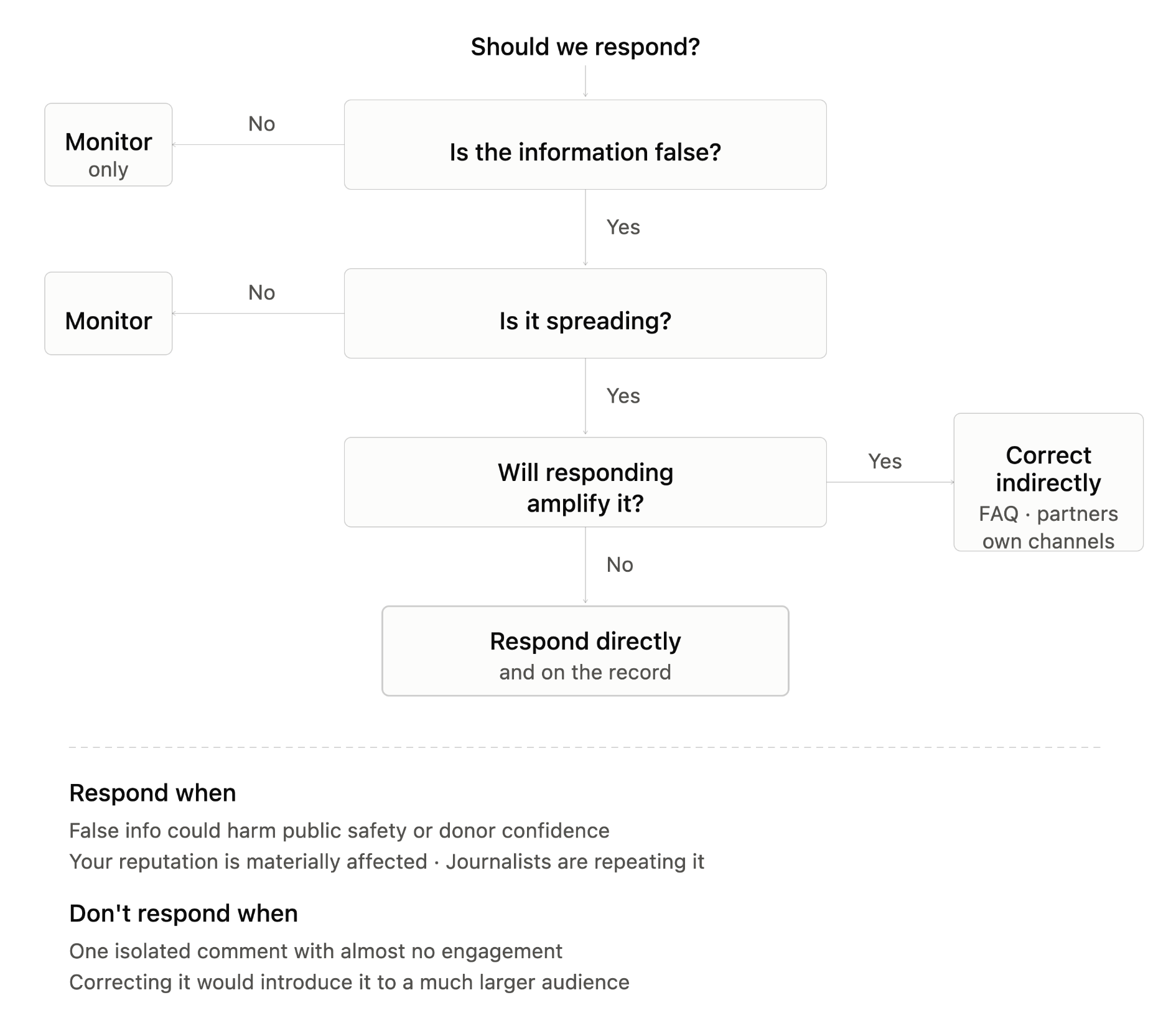
Respond when:
- False information could impact public safety
- Donor confidence could be harmed
- Your reputation is materially affected
- Journalists are repeating it
Don't respond when:
- It's one isolated comment.
- It has almost no engagement.
- Correcting it will introduce it to a much larger audience.