Leading in Turbulent Times: A Growing Demand for Constructive Dialogue

Like many other social sector services, American higher education has been battered by a set of pressures tied to political polarization: escalating campus protests, growing public skepticism, and donor and legislative scrutiny over the past several years. The result: a pervasive sense that the sector is losing its capacity to serve as a credible arena for disagreement, inquiry, and shared problem-solving.
And yet, this is not a story of institutional paralysis. Across higher education, leaders are beginning to respond with greater clarity and intentionality. In my work at the Constructive Dialogue Institute (CDI), a nonpartisan nonprofit focused on equipping campuses to engage differences constructively, I’ve seen a marked shift over the past two years: presidents, provosts, and student affairs leaders are no longer just managing crises — they are actively rebuilding the conditions for productive disagreement that can be applied beyond campus borders.
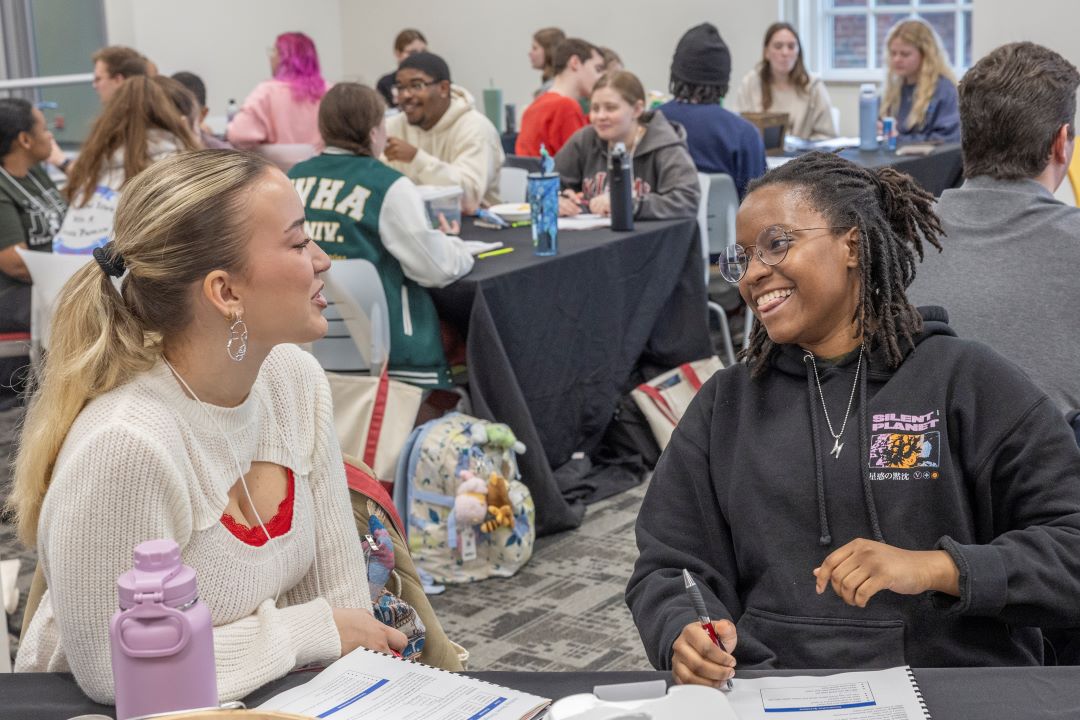
In just the past three years, we’ve seen this shift take root across more than 150 campus partners nationwide—from Ivy League universities to community colleges, from large public flagships to small liberal arts colleges, in urban and rural settings and across red, blue, and purple states.
For example, in October 2025, presidents and senior leaders from Brown, Dartmouth, Duke, Harvard, MIT, NYU, Tufts, Vanderbilt, and Yale convened for CDI’s Leadership Institute to strengthen open inquiry and constructive dialogue on their campuses. These influential private institutions face distinct pressures, yet they share a common recognition: intellectual rigor depends on students’ ability to engage disagreement constructively.
At the same time, the City University of New York, the nation’s largest public urban university system, is partnering with CDI on a multi-year initiative to embed dialogue practices across 26 campuses — the types of skills we will be sharing during our workshop at the 2026 Building Together conference. Faculty, staff, and student leaders are developing facilitation skills, and campuses are integrating dialogue training into orientation and first-year seminars for incoming students.
In Virginia, through our partnership with the State Council of Higher Education for Virginia, 11 public colleges and universities are advancing dialogue initiatives across a state that spans rural, suburban, and urban communities. Despite differing political contexts, leaders are converging around the same priority: students must graduate with the capacity to engage across ideological lines. How did institutions with vastly different student populations and political environments come to see constructive dialogue as core, not peripheral, to their mission?
As Karlyn Crowley, Provost of Ohio Wesleyan University, put it:
“Being able to understand one another, talk to one another, and manage conflict more effectively is the empowering key to not just democracy, but peace. We need that.”
That same conviction is echoed by presidents, provosts, faculty, and student leaders across very different institutions. They are confronting the same underlying reality: disagreement without the skills to navigate it degrades relationships. When faculty fear classroom discussions will spiral, they hesitate to facilitate the very conversations that help students make meaning. Leaders, facing intense scrutiny, prioritize protecting institutional reputation and minimizing risk. Over time, the ability to engage across difference weakens on campus and beyond.
Those investing in this work are not pursuing ideological alignment. They are strengthening the social fabric of their campuses while preparing the next generation for democratic citizenship. They want classrooms where difficult ideas can be tested without dehumanization. They want campus communities where disagreement does not automatically escalate into crisis. And they recognize that these outcomes do not emerge organically. They require intentional skill building, aligned systems, and leadership modeling.
For philanthropy, this convergence presents a clear opportunity. Foundations often invest in democratic resilience, social cohesion, civic participation, and institutional trust. The capacity to engage across difference without dehumanizing one another sits upstream of all four. It is not a temporary response to a news cycle. It is foundational to how institutions and democracies function.
Across institutional types and political geographies, leaders are converging around a simple truth: democracy does not sustain itself. The skills that sustain it must be taught, practiced, and supported.
Join us at Building Together 2026 for a special workshop designed for philanthropic teams to learn and practice strategies for navigating and facilitating conflict, building resilience both inside and outside their organization.
May 5 or 6, 2:30 p.m. – LIMITED SPACE - REGISTER NOW
Leading in Turbulent Times: Building Team Resilience Through Dialogue
What it is: A hands-on workshop that explores how leaders at any level can use constructive dialogue skills to navigate and foster organizational resilience through divided times. Participants will learn and practice strategies for navigating conflict, building trust, and increasing collaboration. Where possible, participants in like roles will be grouped together.
What you’ll learn:
- Understand why constructive dialogue is essential for sustaining strong civic and organizational ecosystems.
- Strengthen trust and collaboration with practical tools for guiding high-stakes conversations.
- Enhance your skills in listening deeply, sharing perspectives authentically, and leading with empathy while holding firm to your values.
- Gain resources to apply bridging practices that amplify the impact and durability of your efforts.
Facilitators: Mylien Duong, Chief Impact Officer, Constructive Dialogue Institute; Caroline Mehl, Co-Founder & Executive Director, Constructive Dialogue Institute