Changing How the World Feeds Itself
For most of his life, John van Hengel had never given much thought to where his next meal was coming from. A successful salesman in California, he'd built a good life. Then, in 1967, circumstances brought him to Phoenix, where he found himself eating at the same soup kitchen where he volunteered.
One day, a mother of 10 told him she was feeding her children on food discarded by grocery stores at the end of the day. Her idea was simple: people and businesses deposit their extra food into a bank that can be used by anyone who needs it.
Van Hengel went to see for himself, digging through grocery store dumpsters to find out just how much was being thrown away. There was plenty.
A $3,000 Loan and an Old Bakery
St. Mary's Basilica, a downtown Phoenix parish, provided a $3,000 loan and an old bakery nearby.
From day one, the food bank was sustained entirely by private donations and volunteers. Van Hengel worked with local grocery stores, food producers, and community organizations to donate their surplus, and St. Mary's handled the collection and distribution.
In its first year, it distributed over 250,000 pounds of food to 36 local charities. By the end of 1968, that number had climbed to roughly a million pounds.
One Volunteer's Enduring Legacy
By 1977, food banks had taken root in 18 cities across the country. Van Hengel built the infrastructure to match—founding Second Harvest in 1979, which grew into America's Second Harvest, and later Feeding America, now the nation's largest domestic hunger-relief organization.
A devout Catholic who had taken a vow of poverty, he went on to establish the Global Food Banking Network before passing away in Phoenix in 2005.
He is rightfully called "the father of food banking."
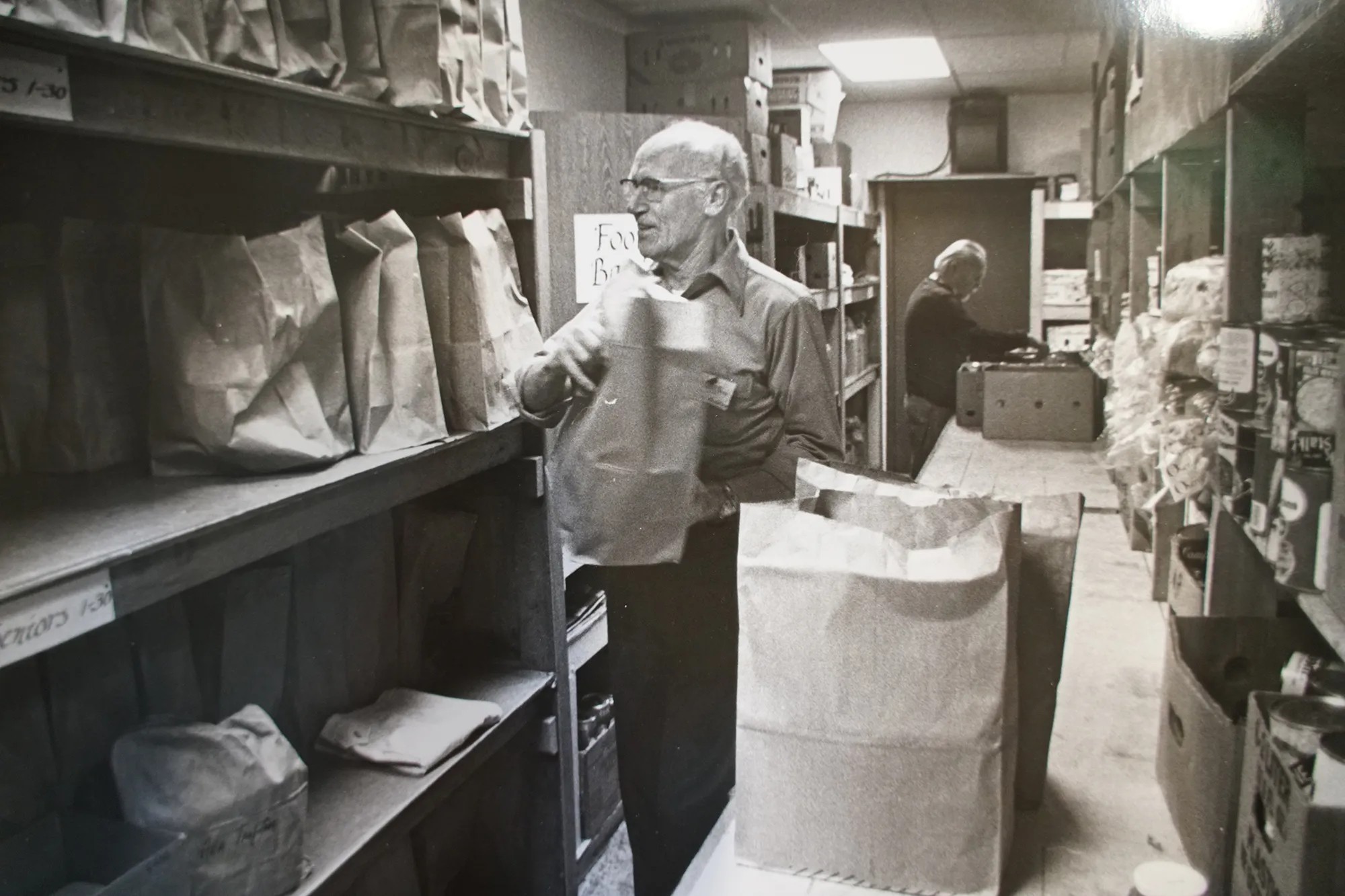
How Food Banks Work
The model St. Mary's pioneered is elegantly simple—and it's now the blueprint for food banks across the country.
A food bank serves as a central hub, collecting donated food from grocery stores, farms, food manufacturers, and community members, then distributing it at no cost to a network of local partner agencies--food pantries, shelters, senior centers, and afterschool programs--who get it directly to the people who need it.
It runs almost entirely on volunteers and donated food. No food is sold. Every pound that would otherwise be thrown away becomes a meal for a neighbor.
That model, born in a donated Phoenix bakery in 1967, now powers more than 250 Feeding America food banks across the country—and countless others worldwide.
Still at It, Nearly 60 Years Later
St. Mary's Food Bank partners with more than 700 organizations across Arizona, distributing 300,000 meals every day to families, children, and seniors struggling to put food on the table. Every $1 donated provides five meals for neighbors across the state, supplied at no cost to partner agencies including food pantries, shelters, senior centers, and afterschool programs. It all started here.
Generosity Builds is a storytelling initiative from the Council on Foundations highlighting the ways charitable foundations show up as a nonpartisan force for good in our communities — from scientific breakthroughs to community childcare, veterans support, and disaster relief.